Myanmar Junta Blames Thailand for Scam Compounds
 Myanmar Junta Blames Thailand for Scam Compounds
KUALA LUMPUR, November 19, 2026 — Myanmar’s military regime has renewed accusations against Thailand over supplies reaching online scam compounds along the border, while avoiding scrutiny of armed groups aligned with the junta that are accused of protecting the criminal operations.
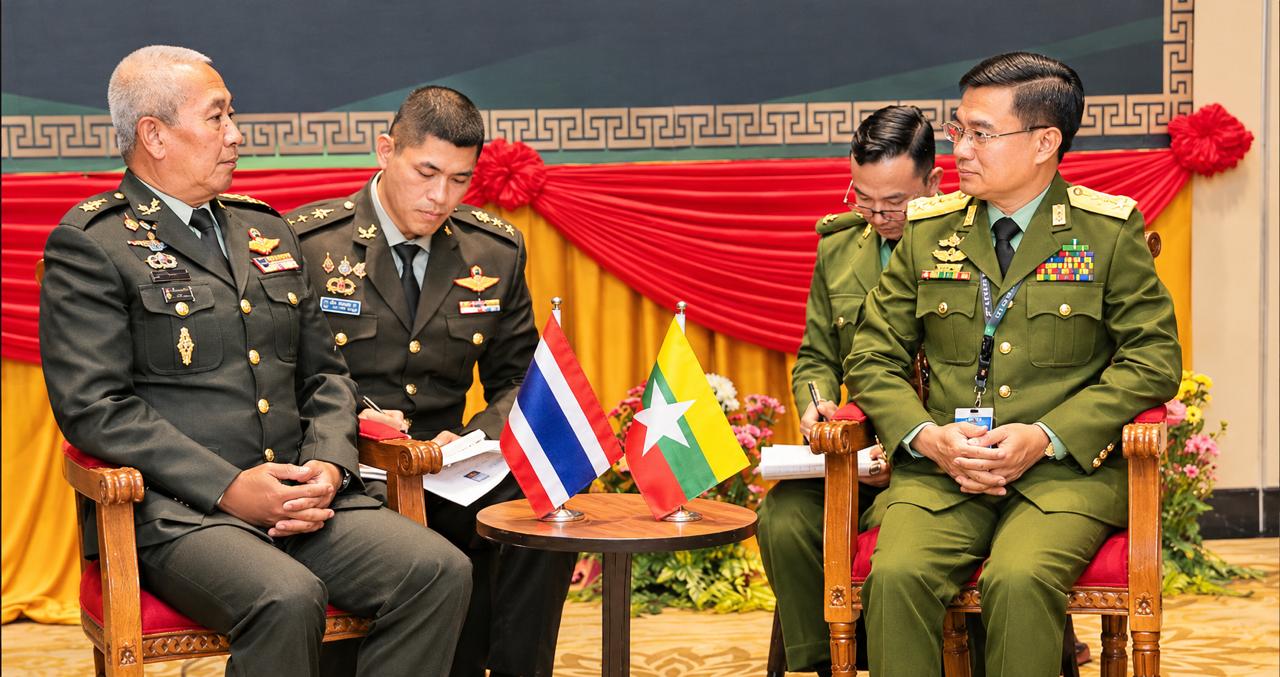
Deputy Commander-in-Chief General Kyaw Swar Lin raised the issue with Royal Thai Army commander-in-chief General Pana Claewplodtook during talks in Malaysia on November 16, according to regime-controlled media.
The meeting took place on the sidelines of the 27th ASEAN Chiefs of Army Multilateral Meeting. Kyaw Swar Lin urged Thailand to stop food, fuel, electricity and telecommunications services from reaching scam syndicates operating in Myanmar’s Karen State.
The two military leaders also discussed military cooperation, border security, narcotics trafficking and illegal cross-border trade.
#Junta Blames Thailand While Avoiding Its Militia Allies
Myanmar’s junta has repeatedly argued since early 2025 that scam compounds around Myawaddy and Shwe Kokko depend on electricity, internet connections and logistical support from Thailand.
However, while Kyaw Swar Lin accused certain insurgent groups of protecting scam syndicates, he did not acknowledge that the groups implicated are aligned with Myanmar’s military regime.
One prominent figure connected to the scam industry is Border Guard Force commander Colonel Saw Chit Thu, whose forces control Shwe Kokko. The United States has imposed sanctions on him over his alleged involvement in online scam operations.
The junta’s attempt to place responsibility on Thailand comes amid growing international pressure, particularly from the United States and China, for stronger action against scam networks operating in Karen State.
The FBI is also cooperating with the Royal Thai Police to tackle cross-border scam operations, including those run by Chinese transnational criminal organisations. US officials estimate that such operations in Myanmar, Laos and Cambodia defraud Americans of US$10 billion annually.
Political analyst Htin Kyaw Aye said the military regime was attempting to distance itself from an issue that has become a major concern for Washington and Beijing.
“Given that these major powers are treating the issue with such concern, it is hardly surprising that the military regime is scrambling to deny any involvement and distance itself from the problem,” he said.
#International Pressure Exposes the Regime’s Contradictions
International efforts to dismantle scam networks have continued to intensify.
This week, the US Embassy in Yangon renewed an offer of up to US$10 million for information leading to the recovery of assets connected to the Tai Chang scam network. The network operates in areas controlled by the junta-aligned Democratic Karen Benevolent Army.
Jeanine Pirro, the US Attorney for the District of Columbia, also arrived in Bangkok for discussions on joint action against transnational scam networks.
Earlier this month, Chinese Foreign Minister Wang Yi urged Myanmar’s military regime to prevent a “resurgence of chaos” in Myawaddy. His remarks followed Beijing’s earlier praise for a Thailand-Myanmar-China mechanism launched in March 2025 to tackle scam compounds in the town.
Meanwhile, recent raids have uncovered scam operations in Yangon and Mandalay. In October, Kyaw Swar Lin reportedly warned senior military officers against involvement in fraud, online gambling and narcotics.
Htin Kyaw Aye said it was “common knowledge” that individuals at different levels of the military regime had benefited from online scams and the drug trade.
Former regime spokesman Major General Zaw Min Tun has previously acknowledged that senior regional and state officials were implicated in such activities, prompting major disciplinary action.
The junta’s renewed demand for Thailand to cut supplies to scam compounds therefore comes amid persistent questions over the role of its own allied armed groups and officials in the criminal networks.